Slow breathing. Vomiting while barely awake. Confusion, seizures, a body that feels cold, skin that looks pale or blue. Alcohol poisoning is a serious medical emergency, and any one of these can be the warning (Mayo Clinic, 2023). When should you call 911? The moment you can’t wake them or their breathing slows. Blood alcohol usually peaks 10 to 60 minutes after drinking, so the danger can keep climbing after the last sip (Jones, 2019).
Is this alcohol poisoning, or are they just really drunk?
You’re standing over someone slumped against the couch, slurring or gone quiet, and you can’t tell whether this is a rough night or an emergency. That’s a hard call, and it gets harder when you’ve been drinking too.
Very drunk and alcohol poisoning sit on the same road. What separates them is whether the body’s automatic systems still work: breathing, temperature control, and the gag reflex, the cough-and-choke response that keeps vomit out of the lungs. When those fade, the brain areas that run them are starting to shut down (National Institute on Alcohol Abuse and Alcoholism, n.d.).
Know the signs. Mayo Clinic lists these warning signs of alcohol poisoning (Mayo Clinic, 2023):
- Confusion
- Vomiting
- Seizures
- Slow breathing, fewer than eight breaths a minute
- Uneven breathing, with gaps of more than 10 seconds
- Skin that looks blue, gray, or pale
- Low body temperature
- Trouble staying conscious or awake
The National Institute on Alcohol Abuse and Alcoholism (NIAAA) adds a slow heart rate, clammy skin, and a missing gag reflex to the signs of an alcohol overdose (NIAAA, n.d.). A person doesn’t need every sign to be in danger, and someone who has passed out can die (Mayo Clinic, 2023). The effects of alcohol reach the brain, heart, stomach, and lungs at once, which is why the signs and symptoms of alcohol poisoning show up in so many places (Vonghia et al., 2008).
Waiting is the most common mistake, and it usually comes from kindness. When college students saw a friend with alcohol poisoning symptoms and didn’t step in, it was mostly because they decided help wasn’t needed (Oster-Aaland et al., 2009).
Watch their chest for 15 seconds, and if it rises fewer than two times, their breathing is too slow. If you can’t wake them, their breathing is slow or uneven, or they’re throwing up while barely awake, treat it as an emergency and call 911.
They may be embarrassed tomorrow, and they’ll be alive to feel it.
Is it a bad hangover the next morning, or something worse?
A hangover is the mix of mental and physical symptoms that shows up the day after heavy drinking, once blood alcohol is close to zero (van Schrojenstein Lantman et al., 2016). Poisoning happens while blood alcohol is still high. The table below compares all three.
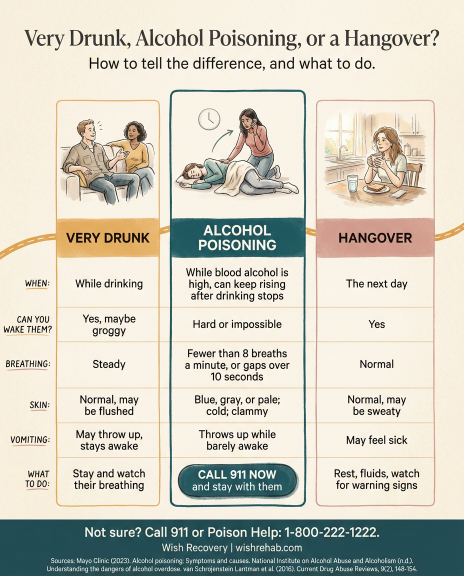
A seizure, confusion, or throwing up blood the next morning still needs medical help.
Can’t I just let them sleep it off? What do I do for alcohol poisoning right now?

Maybe you’re afraid of the police showing up, the bill, or how angry they’ll be when they wake up in a hospital gown. Those fears are real, and they’re why so many people stand there with the phone in their hand and don’t press call.
These steps for when someone is experiencing alcohol poisoning come from NIAAA and Mayo Clinic (NIAAA, n.d.;Mayo Clinic, 2023):
- Call 911 to get help. If you think someone has alcohol poisoning, never assume they’ll sleep it off.
- Stay with them. Someone suffering from alcohol poisoning can fall, choke, or stop breathing when no one’s watching.
- If they’re awake, keep them low and upright. Sit them on the floor, upright or partly upright, and have them lean forward if they vomit.
- If they’re passed out or lying down, roll them onto one side with an ear toward the ground so they don’t choke.
- Keep them warm with a blanket or jacket.
- Give them nothing. No food, no coffee, no more alcohol, and don’t try to make them throw up.
- Tell responders everything. What they drank, how much, when, and any pills, other drugs, or health conditions you know about.
The old fixes feel like doing something. A cold shower, hot coffee, and walking it off don’t reverse an alcohol overdose, and they can make things worse (NIAAA, n.d.).
“Just sleeping” can be a dangerous place to be. On one campus, students sent to the emergency department for drinking averaged a blood alcohol level around 0.19, more than twice the 0.08 driving limit, and one in five was above 0.25 (Kharasch et al., 2016).
Fear of getting in trouble is common enough that schools and states have tried to ease it. After Cornell University stopped disciplining students who called for help in a drinking emergency, more students called (Lewis & Marchell, 2006).
California law offers similar protection. A person under 21 can’t be prosecuted for underage drinking or possession when they call 911 because they or someone else needs medical help from drinking, as long as they’re the first to call. If they called for someone else, they also have to stay until help arrives and cooperate with responders, and the protection doesn’t cover offenses like drunk driving (Cal. Bus. & Prof. Code § 25667).
If you’re a parent on the phone with your college student, keep your voice steady and give one job at a time. Have a roommate check the person’s breathing, call 911, and keep the person right where they are.
The bill is a problem you can solve tomorrow. Tonight, life comes first, and this sentence is worth borrowing: “I’d rather be the friend who overreacted.”
If worry about cost is what keeps you from seeking help for alcohol later, you can check your insurance benefits privately.
How much alcohol does it take, and why does BAC keep climbing after the last drink?
Blood alcohol concentration, or BAC, is the level of alcohol in the blood, and 0.08 is California’s driving limit. When you drink alcohol, it moves from the stomach into the blood over time, and a person’s blood alcohol concentration usually peaks 10 to 60 minutes later. The last two shots are still arriving while the person looks like they’ve settled down (Jones, 2019).
Picture a single checkout lane. The liver clears alcohol in the blood at a steady pace, about 0.015 an hour on average, and nothing speeds it up (Jones, 2019). When someone drinks too much alcohol in a short time, the line backs up fast, and that’s how drinking too much can lead to alcohol poisoning.
How much alcohol is too much to get alcohol poisoning? In 693 Swedish deaths from acute alcohol poisoning, the middle blood alcohol level was 0.36, about four and a half times the driving limit. Some of those deaths happened at levels as low as about 0.07 (Jones & Holmgren, 2003). No amount of alcohol consumed guarantees safety.
The same drinks can land differently in different bodies. Women tend to reach high levels of alcohol on the same number of drinks, partly because the stomach breaks down less alcohol before it gets into the blood (Frezza et al., 1990). Age, tolerance, how fast someone drinks, whether they’ve eaten, and the medications they take all shift the risk for alcohol poisoning too (NIAAA, n.d.).
One serving of alcohol, a standard drink, holds about 14 grams of pure alcohol. Binge drinking means about five drinks for men or four for women in roughly two hours. High-intensity drinking is double that, and teens and college-age adults, who often drink a large amount of alcohol in a short period, face a higher risk of alcohol poisoning (NIAAA, n.d.).
Alcohol with other drugs raises the risk of alcohol overdose even when the drinking seems moderate. Opioids, benzodiazepines like Xanax, sleep aids, and even some allergy medicines also slow breathing, so their effects stack on top of what alcohol affects (NIAAA, n.d.). By 2017, alcohol was involved in about one in seven opioid overdose deaths in the U.S. (Tori et al., 2020).
The wider picture has been moving the wrong way. Over about a decade, binge drinking climbed from roughly one in four adults to one in three (Hingson et al., 2017). Alcohol-related deaths doubled between 1999 and 2017, and nearly one in five came from overdoses on alcohol alone or mixed with other drugs (White et al., 2020).
To prevent alcohol poisoning at the next party, a few habits carry most of the weight. Pace your drinks, skip drinking games and chugging, never mix alcohol with pills, and eat between rounds. Friends can help each other avoid alcohol poisoning by watching whoever drinks more alcohol than everyone else. For a closer look at the clock after the last drink, we explain how long alcohol stays in your system.
What happens at the hospital, and how long does alcohol poisoning last?
If you’re sitting in an emergency department waiting room under the hum of fluorescent lights, it helps to know what’s happening behind those doors. The care team protects breathing and the airway first, and may place a breathing tube if the person can’t breathe well on their own. They check blood sugar and body temperature, give fluids, look for injuries or other drugs, and keep watching until blood alcohol levels fall.
Treatment for alcohol poisoning is mostly careful watching, and an IV bag won’t flush alcohol out faster. In a trial of 144 emergency patients with alcohol intoxication, adding IV saline didn’t shorten their stay, which ran about four and a half hours either way (Perez et al., 2013).
So how long does alcohol poisoning last? Most bodies clear blood alcohol at roughly 0.01 to 0.02 an hour, a bit faster with long-term heavy drinking (Jones, 2010). As a rough estimate, a BAC of 0.30 could take around 20 hours to reach zero, and the effects of alcohol poisoning, the fog, nausea, and exhaustion, can linger after that.
Even the most serious cases often turn a corner within a day with the right support. Among 102 teens admitted to intensive care units in France for alcohol intoxication, more than half needed a breathing tube, and most needed it for less than 12 hours (Ruetsch et al., 2021). Without treatment, the complications of alcohol poisoning can include choking, coma, permanent brain damage, and death (NIAAA, n.d.).
Doctors also recommend looking at the drinking pattern behind it, so a person can be pointed toward care that fits them (Vonghia et al., 2008). For some people, that conversation is the first time anyone has asked.
If you’re the one who woke up in the hospital with a wristband and a blank space where the night should be, the shame can feel enormous. Tell one person you trust what happened this week, because shame gets lighter when someone else is holding a corner of it.
If you’d like to talk through what happened with someone who won’t judge you, reach out to us in confidence. We’ll listen first.
This keeps happening. What is my drinking trying to tell me?

One night doesn’t define anyone. About nine in ten people with excessive alcohol use don’t meet the criteria for alcohol dependence, though the odds rise the more often someone binges (Esser et al., 2014). If this is the second or third scare, that repetition is worth listening to.
You’re far from the only one asking. As excessive alcohol consumption grew, alcohol-related emergency room visits in the U.S. rose by more than 60% between 2006 and 2014 (White et al., 2018).
A short, respectful conversation with a clinician in the ER can lower alcohol consumption and cut down on repeat ER visits (Barata et al., 2017).
Start with the smallest step you can take today. Tell one trusted person what happened, then look honestly at your alcohol use: how often, how much, and what it’s costing you in sleep, money, mornings, or relationships. When you’re ready to seek help, talk confidentially with someone who does assessments for a living.
If a run of heavy nights has you wondering where the line is, we’ve written about what binge drinking does and doesn’t mean. We also explain alcohol use disorder in plain language, the medical name for a drinking pattern that’s causing problems and has gotten hard to control, sometimes still called alcohol abuse or alcohol addiction.
One safety note matters here. If you’ve been drinking every day and get shaky, sweaty, or anxious when you stop, don’t quit suddenly on your own, because withdrawal can be dangerous. Medically supervised alcohol detox makes that first stretch safer.
For anyone struggling with alcohol, help can look more human than people expect. At Wish Recovery, alcohol rehab starts with an individualized plan built around your history, health, and life. Our residential home keeps a small group of about 12 clients so care stays personal and private, and alcohol addiction treatment can move from medical detox to residential treatment to outpatient support without starting over. We also treat anxiety, depression, and trauma alongside drinking, since they’re often tangled together.
Brandon, a former client, put it this way in his Google review: “The staff and counselors are also down to earth, show care and concern for each of us in recovery.”
Another former client, Trevor D., wrote: “If you are looking for a different approach in recovery this is the place… Highly recommend for yourself or loved ones.”
If you’re weighing whether alcohol addiction treatment programs could fit your life, verify your insurance benefits in confidence. It takes a few minutes and commits you to nothing.
Whatever happened tonight, I don’t have to carry what comes next alone
Staying, checking, and calling for help were acts of care, whoever you were in the story tonight. Wanting to understand what happened is a healthy next step, and our door stays open whenever you’re ready. Anything you share with us stays private. The morning comes slowly after a night like this, and you can meet it with someone beside you.
When you’re ready, call or message our team. We’ll start by listening.
We’re sharing this article for informational purposes only, and it isn’t medical advice. If someone may have alcohol poisoning, call 911 right away.
Frequently asked questions about alcohol poisoning
What are the first signs of alcohol poisoning?
The first signs usually include confusion, vomiting, trouble staying awake, slow or uneven breathing, and skin that looks pale, gray, or blue (Mayo Clinic, 2023). A slow heart rate, clammy skin, and a missing gag reflex can show up too (NIAAA, n.d.). Any single sign of alcohol poisoning is enough to call 911.
What BAC is alcohol poisoning?
No single blood alcohol level marks the line. In Swedish poisoning deaths, the middle BAC was 0.36, and some happened near 0.07 (Jones & Holmgren, 2003). Tolerance, body size, sex, and other drugs all shift the risk, so watch the person’s breathing and how awake they are.
Can alcohol poisoning happen the day after drinking?
Yes, in the sense that blood alcohol usually peaks 10 to 60 minutes after the last drink, so someone can get worse after they’ve stopped (Jones, 2019). A hangover begins as blood alcohol nears zero the next day (van Schrojenstein Lantman et al., 2016).
How do I know if my teen has alcohol poisoning?
Teens show the same signs as adults: they’re hard to wake, breathing slowly or unevenly, throwing up while half-conscious, or pale and cold. Call 911, and know that California protects underage callers who call first, stay, and cooperate (Cal. Bus. & Prof. Code § 25667).
Can you die from alcohol poisoning?
Yes. Without treatment, it can lead to choking, coma, permanent brain damage, and death (NIAAA, n.d.). Fast help is what changes the outcome, so if you’re unsure, call.
References
Mayo Clinic. (2023, April 29). Alcohol poisoning: Symptoms and causes. https://www.mayoclinic.org/diseases-conditions/alcohol-poisoning/symptoms-causes/syc-20354386
Jones, A. W. (2019). Alcohol, its absorption, distribution, metabolism, and excretion in the body and pharmacokinetic calculations. WIREs Forensic Science, 1(5), e1340. https://doi.org/10.1002/wfs2.1340
National Institute on Alcohol Abuse and Alcoholism. (n.d.). Understanding the dangers of alcohol overdose. https://www.niaaa.nih.gov/publications/brochures-and-fact-sheets/understanding-dangers-of-alcohol-overdose
Vonghia, L., Leggio, L., Ferrulli, A., Bertini, M., Gasbarrini, G., & Addolorato, G. (2008). Acute alcohol intoxication. European Journal of Internal Medicine, 19(8), 561–567. https://doi.org/10.1016/j.ejim.2007.06.033
Oster-Aaland, L., Lewis, M. A., Neighbors, C., Vangsness, J., & Larimer, M. E. (2009). Alcohol poisoning among college students turning 21: Do they recognize the symptoms and how do they help? Journal of Studies on Alcohol and Drugs, Supplement, (16), 122–130. https://doi.org/10.15288/jsads.2009.s16.122
van Schrojenstein Lantman, M., van de Loo, A. J. A. E., Mackus, M., & Verster, J. C. (2016). Development of a definition for the alcohol hangover: Consumer descriptions and expert consensus. Current Drug Abuse Reviews, 9(2), 148–154. https://doi.org/10.2174/1874473710666170216125822
Kharasch, S. J., McBride, D. R., Saitz, R., & Myers, W. P. (2016). Drinking to toxicity: College students referred for emergency medical evaluation. Addiction Science & Clinical Practice, 11, Article 11. https://doi.org/10.1186/s13722-016-0059-4
Lewis, D. K., & Marchell, T. C. (2006). Safety first: A medical amnesty approach to alcohol poisoning at a U.S. university. International Journal of Drug Policy, 17(4), 329–338. https://doi.org/10.1016/j.drugpo.2006.02.007
Cal. Bus. & Prof. Code § 25667. https://leginfo.legislature.ca.gov/faces/codes_displaySection.xhtml?lawCode=BPC§ionNum=25667
Jones, A. W., & Holmgren, P. (2003). Comparison of blood-ethanol concentration in deaths attributed to acute alcohol poisoning and chronic alcoholism. Journal of Forensic Sciences, 48(4), 874–879. https://doi.org/10.1520/JFS2002420
Frezza, M., di Padova, C., Pozzato, G., Terpin, M., Baraona, E., & Lieber, C. S. (1990). High blood alcohol levels in women: The role of decreased gastric alcohol dehydrogenase activity and first-pass metabolism. New England Journal of Medicine, 322(2), 95–99. https://doi.org/10.1056/NEJM199001113220205
Tori, M. E., Larochelle, M. R., & Naimi, T. S. (2020). Alcohol or benzodiazepine co-involvement with opioid overdose deaths in the United States, 1999-2017. JAMA Network Open, 3(4), e202361. https://doi.org/10.1001/jamanetworkopen.2020.2361
Hingson, R. W., Zha, W., & White, A. M. (2017). Drinking beyond the binge threshold: Predictors, consequences, and changes in the U.S. American Journal of Preventive Medicine, 52(6), 717–727. https://doi.org/10.1016/j.amepre.2017.02.014
White, A. M., Castle, I.-J. P., Hingson, R. W., & Powell, P. A. (2020). Using death certificates to explore changes in alcohol-related mortality in the United States, 1999 to 2017. Alcoholism: Clinical and Experimental Research, 44(1), 178–187. https://doi.org/10.1111/acer.14239
Perez, S. R., Keijzers, G., Steele, M., Byrnes, J., & Scuffham, P. A. (2013). Intravenous 0.9% sodium chloride therapy does not reduce length of stay of alcohol-intoxicated patients in the emergency department: A randomised controlled trial. Emergency Medicine Australasia, 25(6), 527–534. https://doi.org/10.1111/1742-6723.12151
Jones, A. W. (2010). Evidence-based survey of the elimination rates of ethanol from blood with applications in forensic casework. Forensic Science International, 200(1–3), 1–20. https://doi.org/10.1016/j.forsciint.2010.02.021
Ruetsch, V., Zarka, J., Vanel, B., Tissieres, P., Megarbane, B., Renolleau, S., Dauger, S., Guilbert, A.-S., Leteurtre, S., Charpentier, J., Vaugier, I., & Bergounioux, J. (2021). Pediatric acute alcohol intoxication admitted to the ICU: A review of 102 cases in France. Critical Care Medicine, 49(9), e833–e839. https://doi.org/10.1097/CCM.0000000000005032
Esser, M. B., Hedden, S. L., Kanny, D., Brewer, R. D., Gfroerer, J. C., & Naimi, T. S. (2014). Prevalence of alcohol dependence among US adult drinkers, 2009–2011. Preventing Chronic Disease, 11, 140329. https://doi.org/10.5888/pcd11.140329
White, A. M., Slater, M. E., Ng, G., Hingson, R., & Breslow, R. (2018). Trends in alcohol-related emergency department visits in the United States: Results from the Nationwide Emergency Department Sample, 2006 to 2014. Alcoholism: Clinical and Experimental Research, 42(2), 352–359. https://doi.org/10.1111/acer.13559
Barata, I. A., Shandro, J. R., Montgomery, M., Polansky, R., Sachs, C. J., Duber, H. C., Weaver, L. M., Heins, A., Owen, H. S., Josephson, E. B., & Macias-Konstantopoulos, W. (2017). Effectiveness of SBIRT for alcohol use disorders in the emergency department: A systematic review. Western Journal of Emergency Medicine, 18(6), 1143–1152. https://doi.org/10.5811/westjem.2017.7.34373



 October 30, 2026
