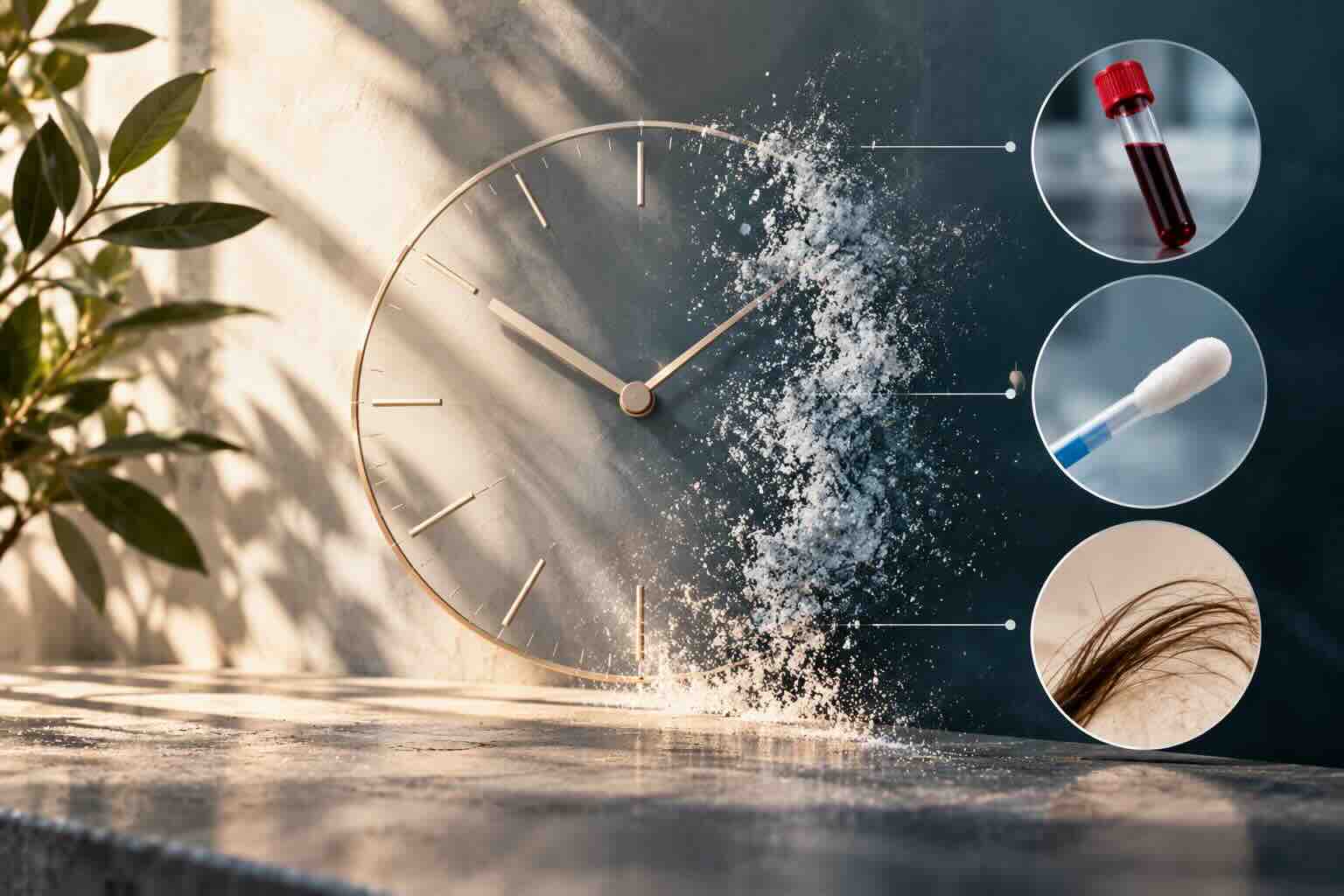
Cocaine has a short half-life, about an hour, so it leaves the bloodstream quickly (Jeffcoat et al., 1989). Tests can detect cocaine use through its main metabolite, benzoylecgonine, which lingers much longer. After a single use, urine tests typically turn negative within about one to two days at standard cutoffs (Cone et al., 2003), while chronic use can stretch that to a week or more (Preston et al., 2002). Saliva and blood windows are shorter, often hours to about two days (Verstraete, 2004). Hair can show a pattern of use for roughly three months (Marrinan et al., 2017).
How long will cocaine show up in my urine, blood, saliva, or hair?
It depends on the type of drug test, the dose, and the lab. Most tests don't hunt for cocaine itself. They look for a metabolite, which is a leftover the body makes from cocaine, because it can stay in the system longer than cocaine does. A lab also calls a result positive only above a set amount, called a cutoff, measured in nanograms per milliliter (ng/mL). The same urine sample can read negative at one lab and positive for cocaine at another.
|
How long cocaine can be detected, by test type
|
|
Test type
|
After a single or occasional use
|
After heavy or frequent use
|
What the test looks for
|
|
Urine
|
About 1.5 days at a 300 ng/mL cutoff, about 2 days at lower cutoffs (Cone et al., 2003). General single-use range: 1.5–4 days (Verstraete, 2004).
|
About 3 days on average, up to about 7 days in chronic users (Preston et al., 2002). Up to about 3 weeks in long-term heavy use* (Weiss & Gawin, 1988).
|
Benzoylecgonine, cocaine's main metabolite (SAMHSA, 2026).
|
|
Blood
|
Cocaine itself for a few hours; plasma half-life of about 1.5 hours (Jufer et al., 2000). Most drugs of abuse are detectable for about 1–2 days (Verstraete, 2004).†
|
Not well established in controlled studies for cocaine specifically.‡
|
Cocaine and benzoylecgonine; cocaethylene if alcohol is involved (Jones, 2019).
|
|
Saliva (mouth swab)
|
Hours, up to about 2 days (Verstraete, 2004).† Cocaine half-life in saliva is about 1.2 hours (Jufer et al., 2000).
|
Longer: repeated dosing extended detection about 4 times for cocaine and about 7 times for benzoylecgonine compared with a single dose (Jufer et al., 2006).
|
Mostly cocaine itself; metabolite levels in saliva stay low (Cone et al., 1997).
|
|
Hair
|
May not detect a single use; the most recent days are usually missed (Marrinan et al., 2017).
|
About 3 months for a standard 3 cm (about 1.5 inch) scalp sample (Marrinan et al., 2017; Society of Hair Testing, 2022).
|
Cocaine plus metabolites: benzoylecgonine, norcocaine, cocaethylene (Society of Hair Testing, 2021).
|
* Reported in long-term, high-dose users. A citing study describes benzoylecgonine detected in urine up to 21 days after the last use (Nickley et al., 2017). Most people clear far sooner.
† General figure for drugs of abuse, not a cocaine-only measurement.
‡ No controlled study measured this directly, so we don't give a number.
These detection windows by test type come from published research. Your own result can differ based on how much was used, how often, the lab's cutoff, and how your body processes cocaine.
How long does cocaine stay in my urine?
In a study of six healthy men given single doses, the last consecutive positive urine drug screen came about 32.8 hours after use at a 300 ng/mL cutoff, and about 50.6 hours at 50 ng/mL (Cone et al., 2003). "Last consecutive positive" means the last test in a row that came back positive before turning negative. Among 18 chronic users, the average was about 81 hours, and 63% would still test positive for cocaine past 48 hours (Preston et al., 2002). In long-term heavy users, the urine detection window reaches up to about three weeks (Nickley et al., 2017; Weiss & Gawin, 1988).
So if it was one night, the time cocaine stays in urine is usually shorter than your fear is telling you. If it's been every weekend for months, the window stretches, and that's worth noticing too.
How long does cocaine stay in my blood?
In the blood, cocaine remains for only a few hours, with a plasma half-life of about 1.5 hours (Jufer et al., 2000). Across drugs of abuse, blood testing detects use for about one to two days (Verstraete, 2004). We don't give a heavy-use number, because controlled studies haven't measured one.
What about a mouth swab?
Oral fluid is saliva, collected with a swab. Saliva tests can detect cocaine itself best, because metabolite levels in saliva stay low (Cone et al., 1997). Repeated dosing stretched detection about four times for cocaine and seven times for benzoylecgonine (Jufer et al., 2006).
Can a hair test go back months?
Hair grows about 1 cm a month, so in a standard 3 cm sample cut close to the hair follicle, cocaine is detectable for about three months (Marrinan et al., 2017; Society of Hair Testing, 2022). The newest days are still under the skin when the sample is cut, so recent cocaine use is missed, and a single use may escape detection.
If you're a parent holding a home cocaine test, know that it shows only that something crossed a cutoff. It can't tell you how much, how recently, or how often.
The high wore off hours ago, so why is my body still holding on to it?

Because the drug leaves first and its shadow leaves later. Cocaine is a powerful stimulant, and the rush cocaine produces in the central nervous system is brief. Half-life is the time the body needs to clear half of a substance from the blood. Cocaine's is about an hour, which is why the effects of cocaine fade fast (Jeffcoat et al., 1989).
When cocaine is metabolized, enzymes in the liver and blood act like scissors. Breaking down cocaine into smaller pieces helps the kidneys eliminate cocaine and its metabolites. One liver enzyme forms benzoylecgonine (say it ben-zoyl-EK-go-neen). Other enzymes form a second product, and together the two make up about 95% of what shows up in urine (Jastrzębska & Daniel, 2023). Only about 2% of a dose leaves as unchanged cocaine, and benzoylecgonine has a half-time of about 4.5 hours, compared with about one hour for cocaine (Ambre et al., 1988).
That's the fingerprint a cocaine drug test hunts for. Federal workplace testing screens at 150 ng/mL and confirms at 100 ng/mL of benzoylecgonine (SAMHSA, 2026).
Four factors that affect how long cocaine stays detectable stand out: how much was used, how often (Preston et al., 2002; Jufer et al., 2006), the cutoff a lab uses, and whether alcohol was involved. Your own cocaine metabolism and organ function matter too. Other substances run on their own clocks, and you can see how long Adderall stays in your system as well.
Drinking lots of water doesn't change this. In one study, about a gallon of fluid produced dilute urine in roughly 1.45 hours, and negative results quickly reverted to positive once the dilution wore off. Herbal detox claims appeared unfounded (Cone et al., 1998). Labs also measure creatinine and flag specimens that are too watery (HHS, 2017).
Detected doesn't mean impaired. That gap between how you feel and what a test says about cocaine in your system can feel unfair. It's simply chemistry.
If a result is worrying you, we can help you understand your next steps. We accept most insurance plans, so you can check your coverage here.
Does mixing cocaine and alcohol keep it in my system longer, or make it more dangerous?
More dangerous. When cocaine and alcohol meet in the liver, the body makes a third substance called cocaethylene. It forms only when both are present together. Cocaethylene has a longer half-life than cocaine, about two hours in plasma compared with about one, so it stays in the blood several hours longer. It's considered more toxic to the heart and liver (Jones, 2019). Another study measured 1.68 hours for cocaethylene against 1.07 hours for cocaine (Perez-Reyes et al., 1994).
Combining cocaine with alcohol also makes simple math unreliable. In ten volunteers given cocaine an hour after alcohol, about 17% of the cocaine converted to cocaethylene, and drinking first lowered urine benzoylecgonine by 48% (Harris et al., 2003). Combined use pushed heart rate up more than each substance alone, with up to 30% higher blood cocaine levels (Pennings et al., 2002).
If you didn't know this was a thing, you're in good company. Most people don't.
And what if I don't know what was in it?
Mixing substances is called polysubstance use, a pattern of drug use that can include things you never chose. In 2017, 72.7% of cocaine-involved overdose deaths also involved opioids, and synthetic opioids, mainly illicitly made fentanyl, drove the increase (Kariisa et al., 2019). In 2022, 53.6% of synthetic-opioid deaths also involved stimulants (Lundstrom et al., 2025). You can read more about fentanyl in the drug supply.
Fentanyl test strips can help people check for it. Among 125 people who inject drugs, 63% got a positive strip, and 43% changed how they used (Peiper et al., 2019).
If someone may have taken fentanyl and is unresponsive or breathing slowly, call 911.
Could something other than cocaine make my drug test come back positive?
If you're a parent or partner holding a result, you may feel exhausted, hopeful, guilty, and skeptical all at once. All of that makes sense.
First, the drug screen. An immunoassay is a fast first test where antibodies latch onto a specific molecular shape. A false positive happens when another substance is shaped enough like the target to fool it. For cocaine metabolite screens that's rare, and common numbing drugs such as lidocaine, bupivacaine, and procaine don't cause false positives (Krasowski et al., 2009).
There are real sources of cocaine metabolites, though:
- Coca leaf tea. One cup of Peruvian or Bolivian tea held about 4.1 to 4.3 mg of cocaine, and urine benzoylecgonine reached near 4,000 to 5,000 ng/mL, well above cutoffs (Jenkins et al., 1996). All five volunteers who drank it tested positive by two hours, and three of five were still positive at 36 hours (Mazor et al., 2006).
- Medical use. Topical 4% cocaine for nasal procedures is absorbed, about 4%, and metabolites appeared in urine (McGrath et al., 2019).
- Secondhand smoke. In an unventilated room with crack cocaine smoke, benzoylecgonine peaked at 22 to 123 ng/mL in people who were there. Staff near smokers reached at most 6 ng/mL. Both were too low for a positive result at federal cutoffs (Cone et al., 1995).
- Hair type. Hair from different people absorbed different amounts of cocaine under identical conditions (Kidwell et al., 2000).
A positive screen is followed by a confirmatory test and a clinical review. The second test confirms the presence of cocaine or its metabolites by identifying the exact molecule by its weight, and in workplace testing a reviewing doctor looks at the result (Moeller et al., 2017).
So if you had coca tea or a nasal procedure, tell the reviewing doctor. If you were near smoke, the research says levels stay below cutoffs. If you're a parent with a home test for cocaine, a positive screen is a reason for a calm conversation and a confirmatory lab test before conclusions.
If you were honestly only around it, the research is on your side. If you weren't, you deserve real support, and that's what the rest of this article is about.
If you're not sure how to begin with someone you love, you can call or message us privately. Questions are welcome.
The test will clear eventually. So why do I still feel this low, and what happens next?
If the crash of cocaine withdrawal is what's keeping you up, you're not imagining it. In a 28-day residential study of 12 men with cocaine addiction and 10 comparison participants, mood distress, depression, and craving were highest at admission and then decreased gradually and steadily (Weddington et al., 1990). Another study of 30 chronic users described a three-phase sequence after stopping, and over half met criteria for another psychiatric disorder (Gawin & Kleber, 1986). That's why we offer cocaine addiction treatment alongside care for depression and anxiety alongside cocaine use.
Feeling this low is a sign your brain is recalibrating, and you don't have to sit through that alone.
There's a safety side, too. In 3,946 heart attack patients, risk was nearly 24 times higher than baseline in the hour after cocaine use, then fell quickly (Mittleman et al., 1999). The chance for any one person is still low, but chest pain after use is never something to wait out (McCord et al., 2008).
Call 911 for chest pain, a racing or irregular heartbeat, trouble breathing, confusion, or seizures after cocaine use. If you have thoughts of suicide or self-harm, call or text 988. For a free, confidential treatment referral, the SAMHSA National Helpline is 1-800-662-HELP (4357), open 24/7, 365 days a year (SAMHSA, n.d.).
No medication is approved for cocaine use disorder in the US or Europe, based on a review of 157 studies and 15,842 participants (Bentzley et al., 2021). There's no pill for this yet, which is why steady, structured human support matters in treatment for cocaine addiction.
Three private questions can show you where you stand. Did I use cocaine more than I planned? Have I tried to cut back and found it harder than I expected? Am I timing my life around tests? If any of them landed, one small step is a confidential conversation that commits you to nothing.
At Wish Recovery, we care for 12 clients at a time, which means more attention and more privacy. Our medically supervised drug detox offers stabilization when the crash, sleep, mood, or heart symptoms need monitoring. Residential care follows, and our continuity program and IOP with an alumni program carry support forward. If your test is tied to your job, a conversation with us can start with that worry.
One former client, Steven S., wrote: “From day one, I felt welcomed, supported, and truly cared for by everyone at the facility... The personalized approach and attention to detail that each staff member brings to their role made such a positive difference in my experience.”
If cost is on your mind, you can see how insurance works with us. Questions about coverage are welcome.
Whatever the test says, I don't have to figure out the rest alone
A number on a test is one small piece of information about a much larger, more human story. It can't tell you how you slept, what you're carrying, or who's worried about you.
Looking this up was reasonable, and it took some courage. The low after cocaine tends to lift, and asking a question doesn't commit you to anything.
Our door is open whenever you're ready to talk. Support doesn't stop at a test result or a discharge date, because our continuity program and alumni community stay with you after residential care. Calls are private, and nothing is shared without your consent.
Some doors stay unlocked long after the night that sent you searching for this page. Ours is one of them.
When you're ready, you can start a private conversation with us. It can be as short as a single question.
This article is for informational purposes only. It isn't medical advice, diagnosis, or treatment, and it doesn't replace guidance from a qualified healthcare professional. In an emergency, call 911.
What else am I still wondering about cocaine and drug tests?
Will cocaine show up on a drug test after one use?
Usually, yes, for a short time. After a single use of cocaine, urine tests typically turn negative within about one to two days at standard cutoffs (Cone et al., 2003). The cocaine detection time for saliva and blood is shorter. A hair test may miss a single use (Marrinan et al., 2017).
What does cocaine show up as on a drug test?
Most tests detect cocaine metabolites, chiefly benzoylecgonine, the leftover the body makes from cocaine. If alcohol was involved, tests may also find cocaethylene, the third substance formed when the two mix (Jones, 2019).
What is the half-life of cocaine?
About one hour, meaning the blood clears half of it in that time (Jeffcoat et al., 1989). Benzoylecgonine stays in your body longer, with a half-time of about 4.5 hours (Ambre et al., 1988).
Can a hair test detect cocaine from months ago?
Yes, in a pattern. A standard 1.5-inch (about 3 cm) sample reflects about three months (Marrinan et al., 2017; Society of Hair Testing, 2022). It shows a pattern of use more reliably than a single use.
Can drinking water or a detox drink flush cocaine out faster?
There's no reliable evidence that it shortens how long cocaine stays in the body. Labs flag dilute samples, and results can turn positive again once the dilution wears off (Cone et al., 1998; HHS, 2017).
- Jeffcoat, A. R., et al. (1989). Drug Metabolism and Disposition, 17(2), 153–159. https://doi.org/10.1016/s0090-9556(25)08737-9
- Cone, E. J., et al. (2003). Journal of Analytical Toxicology, 27(7), 386–401. https://doi.org/10.1093/jat/27.7.386
- Preston, K. L., et al. (2002). Journal of Analytical Toxicology, 26(7), 393–400. https://doi.org/10.1093/jat/26.7.393
- Verstraete, A. G. (2004). Therapeutic Drug Monitoring, 26(2), 200–205. https://doi.org/10.1097/00007691-200404000-00020
- Marrinan, S., et al. (2017). Human Psychopharmacology, 32(3), e2587. https://doi.org/10.1002/hup.2587
- Weiss, R. D., & Gawin, F. H. (1988). American Journal of Medicine, 85(6), 879–880. https://doi.org/10.1016/s0002-9343(88)80042-1
- SAMHSA. (2026, March 13). Mandatory guidelines for federal workplace drug testing programs: Authorized testing panels. Federal Register, 91, 12308. https://www.federalregister.gov/documents/2026/03/13/2026-04981/mandatory-guidelines-for-federal-workplace-drug-testing-programs-authorized-testing-panels
- Jufer, R. A., et al. (2000). Journal of Analytical Toxicology, 24(7), 467–477. https://doi.org/10.1093/jat/24.7.467
- Jones, A. W. (2019). Journal of Analytical Toxicology, 43(3), 155–160. https://doi.org/10.1093/jat/bkz007
- Jufer, R., et al. (2006). Journal of Analytical Toxicology, 30(7), 458–462. https://doi.org/10.1093/jat/30.7.458
- Cone, E. J., Oyler, J., & Darwin, W. D. (1997). Journal of Analytical Toxicology, 21(6), 465–475. https://doi.org/10.1093/jat/21.6.465
- Society of Hair Testing. (2022). 2022 SoHT consensus on general recommendations for hair testing.https://www.soht.org/images/pdf/General_Consensus_Hair_Testing_2022.pdf
- Society of Hair Testing. (2021). 2021 SoHT consensus on drugs of abuse testing in hair.https://www.soht.org/images/pdf/Consensus_DoA_2021.pdf
- Nickley, J., et al. (2017). Drug Testing and Analysis, 9(8), 1214–1216. https://doi.org/10.1002/dta.2153
- Ambre, J., et al. (1988). Journal of Analytical Toxicology, 12(6), 301–306. https://doi.org/10.1093/jat/12.6.301
- Jastrzębska, J., & Daniel, W. A. (2023). International Journal of Molecular Sciences, 24(2), 1632. https://doi.org/10.3390/ijms24021632
- Cone, E. J., et al. (1998). Journal of Analytical Toxicology, 22(6), 460–473. https://doi.org/10.1093/jat/22.6.460
- U.S. Department of Health and Human Services. (2017, January 23). Mandatory guidelines for federal workplace drug testing programs. Federal Register, 82, 7920. https://www.federalregister.gov/documents/2017/01/23/2017-00979/mandatory-guidelines-for-federal-workplace-drug-testing-programs
- Perez-Reyes, M., et al. (1994). Psychopharmacology, 116(4), 428–432. https://doi.org/10.1007/bf02247473
- Harris, D. S., et al. (2003). Drug and Alcohol Dependence, 72(2), 169–182. https://doi.org/10.1016/s0376-8716(03)00200-x
- Pennings, E. J. M., et al. (2002). Addiction, 97(7), 773–783. https://doi.org/10.1046/j.1360-0443.2002.00158.x
- Kariisa, M., et al. (2019). MMWR, 68(17), 388–395. https://doi.org/10.15585/mmwr.mm6817a3
- Lundstrom, E., et al. (2025). MMWR, 74(10), 173–178. https://doi.org/10.15585/mmwr.mm7410a3
- Peiper, N. C., et al. (2019). International Journal of Drug Policy, 63, 122–128. https://doi.org/10.1016/j.drugpo.2018.08.007
- Krasowski, M. D., et al. (2009). BMC Emergency Medicine, 9, 5. https://doi.org/10.1186/1471-227x-9-5
- Jenkins, A. J., et al. (1996). Forensic Science International, 77(3), 179–189. https://doi.org/10.1016/0379-0738(95)01860-3
- Mazor, S. S., et al. (2006). European Journal of Emergency Medicine, 13(6), 340–341. https://doi.org/10.1097/01.mej.0000224424.36444.19
- McGrath, J., et al. (2019). American Journal of Rhinology & Allergy, 34(3), 336–341. https://doi.org/10.1177/1945892419896241
- Cone, E. J., et al. (1995). Journal of Analytical Toxicology, 19(6), 399–411. https://doi.org/10.1093/jat/19.6.399
- Kidwell, D. A., et al. (2000). Forensic Science International, 107(1–3), 39–61. https://doi.org/10.1016/s0379-0738(99)00148-6
- Moeller, K. E., et al. (2017). Mayo Clinic Proceedings, 92(5), 774–796. https://doi.org/10.1016/j.mayocp.2016.12.007
- Weddington, W. W., et al. (1990). Archives of General Psychiatry, 47(9), 861–868. https://doi.org/10.1001/archpsyc.1990.01810210069010
- Gawin, F. H., & Kleber, H. D. (1986). Archives of General Psychiatry, 43(2), 107–113. https://doi.org/10.1001/archpsyc.1986.01800020013003
- Mittleman, M. A., et al. (1999). Circulation, 99(21), 2737–2741. https://doi.org/10.1161/01.cir.99.21.2737
- McCord, J., et al. (2008). Circulation, 117(14), 1897–1907. https://doi.org/10.1161/CIRCULATIONAHA.107.188950
- Bentzley, B. S., et al. (2021). JAMA Network Open, 4(5), e218049. https://doi.org/10.1001/jamanetworkopen.2021.8049
- SAMHSA. (n.d.). SAMHSA's National Helpline. https://www.samhsa.gov/find-help/helplines/national-helpline



 October 06, 2026

