Dual diagnosis—the clinical term for having a mental health condition and a substance use disorder at the same time—is far more common than most people realize. Research consistently shows that more than half of people in substance use treatment have also experienced a mental health disorder, and the reverse is equally true. For retired athletes and high-performing professionals, depression, anxiety, and alcohol misuse frequently appear together because they share the same roots: identity loss, chronic pain, and the absence of the structure that once organized everything. Treating one without the other is often why previous attempts at recovery didn't hold.
What the FIFA World Cup 2026 brings up that nobody talks about
The game is on. Maybe you've been watching every match, or maybe this year you're watching differently—with something heavier than enthusiasm sitting in the room with you.
It might be a former player's face on the broadcast, just for a second, before he straightens up and goes back to being composed. It might be the third drink you poured before you meant to. It might be something you can't quite name, tied to a version of yourself that used to be on a pitch somewhere, or in a locker room, or at a stadium watching the sport that made you feel like you belonged to something.
FIFA World Cup 2026 is soccer's biggest stage, and for millions of fans, it carries personal meaning that goes far beyond the scoreboard. For former footballers, that weight is particularly real. Studies show that alcohol misuse hits retired male footballers at alarming rates—in one Australian study, nearly seven in ten screened positive, far higher than players who were still active (Kiliç et al., 2021). Across the board, retired players tend to struggle more with mental health, and the two riskiest moments are when injury forces someone out and when a career ends (Woods et al., 2022).
The World Cup makes all of that visible again. The stadium lights, the crowd, the sport—and, for some people, a feeling they've been quietly carrying for a long time.
What happens to a player when the final whistle is the last one they'll ever hear
For most people watching the World Cup, the game ends and life continues. For a professional footballer, the day their career ends is the day the scaffolding of their entire identity comes down.
That's not a dramatic overstatement. When you've spent your formative years in a sport—training, competing, building your self-worth inside the structure of a team and a game—your identity and your athletic role become inseparable. You're not someone who plays soccer. You are a soccer player. And when that ends, the loss is something most people around the player don't know how to name, and the player himself may not be able to name it either.
Former professional footballers who screened positive for depression were more likely to be younger, more recently retired, to have a higher sense of athletic identity, and to have left the game because of injury—a cluster of risk factors that all come together precisely at the moment careers end (Sanders & Stevinson, 2017). When researchers looked at what retirement from sport actually does to people, the picture was consistent: the loss of identity, the disappearance of the social world built around the game, and a real uptick in anxiety, depression, and alcohol misuse among those who'd left (Voorheis et al., 2023).
The game didn't just take their time. It took their framework for understanding who they were.
This extends beyond professional players. Anyone for whom sport was a central organizing force—recreational leagues, college teams, the weekend game that felt like the one place you were fully yourself—carries some version of this when it ends.
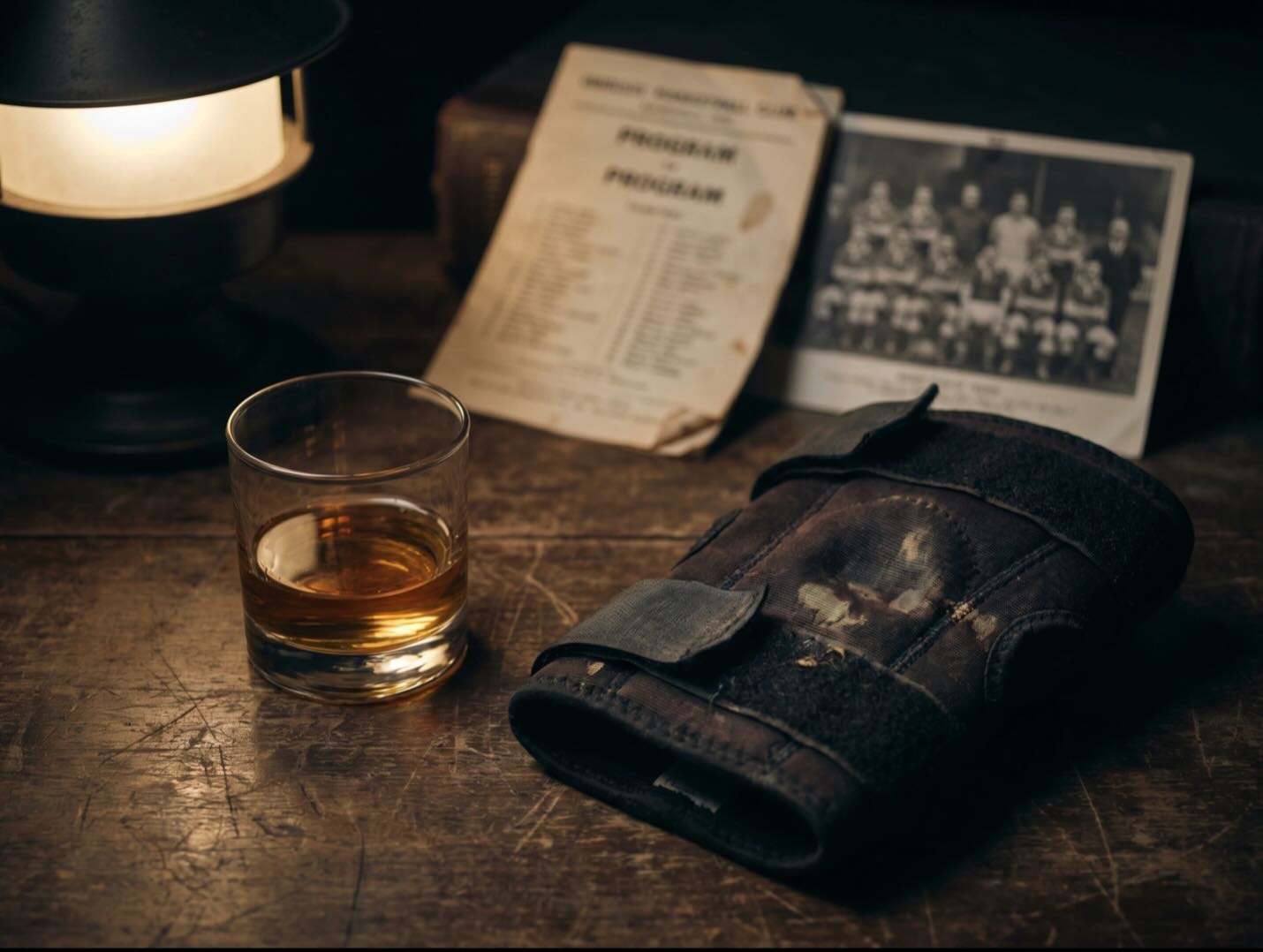
When the body keeps score of every tackle, and the drinking starts to feel like medicine
After the identity piece, there's the body. And the body tells a different kind of story.
Years of professional play leave a physical record—in knees, hips, ankles, in the places that ache when the weather changes or when you sit still too long. Retired professional footballers carry a significant burden of musculoskeletal conditions, including osteoarthritis of the hip, knee, and ankle, as well as mental health symptoms—and these two categories are closely connected rather than separate (Carmody et al., 2022). Former players dealing with chronic pain are at meaningfully higher risk for depression, making physical pain more than a medical issue—it becomes a mental health risk factor, too (Sanders & Stevinson, 2017).
What fills that gap, for a lot of former athletes, is familiar: alcohol, prescription medications, substances that were already part of the landscape of pain management during their playing years. Research on retired professional football players found a strong link between heavy drinking and both current prescription opioid use and misuse—revealing how tightly the management of physical pain and alcohol use are woven together in this population (Cottler et al., 2011).
The body and the mind don't file their pain separately. When a retired athlete reaches for a drink to quiet a knee that won't settle, or to get to sleep without the ache that's always there, they're not making a moral choice. They're doing what the body has learned to do—reach for something that works, even when it stops working, even when it starts costing more than it gives.
The sport that made you strong also taught you to stay quiet
Here's something worth sitting with: the same culture that built elite athletes also built an almost perfect system for keeping them from getting help.
High-performance sport—soccer included—runs on a very specific message: push through, stay tough, show nothing. The "no pain, no gain" culture doesn't just apply to the physical. For male athletes, that pressure gets turned up even louder. The bigger your name, the less room you have to admit anything is wrong (Aditya et al., 2024). That's not a character flaw. That's a professional environment that rewarded suppression so consistently, for so long, that asking for help starts to feel like a betrayal of who you're supposed to be.
Even after the career ends, the culture doesn't leave. It migrates into everyday life—into the office, the home, the way a former athlete sits with difficulty rather than naming it. One study found that nearly a third of retired professional soccer players dealt with anxiety or depression in a given year—and most of them weren't getting help for it (Oltmans et al., 2021).
This section of the story matters because it explains the silence. Choosing not to reach out isn't always a lack of motivation. Sometimes it's the result of years of conditioning that made silence feel like strength. If you recognize that pattern, you're not alone in it—and you didn't create it.
Many members of our clinical team at Wish Recovery have walked away from something that once defined them. The experience of rebuilding identity and asking for help from the inside—not from a textbook—is part of what we bring to this work.
You don't have to have it all figured out before you call.
Verify your insurance here and let us help you understand your options.
Is it the depression or the drinking—and does it matter which came first
This is one of the most common things people carry into treatment: the sense that they need to figure out the "real" problem before they can do anything about it. If they could just determine whether the depression caused the drinking, or the drinking caused the depression, they'd know what to fix.
The clinical answer, supported by decades of research, is that both conditions are real, and both need to be in the room at the same time. More than half of people in substance use treatment have also experienced a mental health disorder, and integrated treatment—where both are addressed simultaneously—consistently leads to better outcomes than treating each one separately (Padwa et al., 2013). A comprehensive review of dual diagnosis programs found that integrated outpatient treatment, with case management and a motivational, stage-appropriate approach, produced the most consistent evidence for helping people reduce substance use and stabilize their mental health (Drake et al., 1998).
For retired athletes and former players, the sequence often follows a recognizable path: the career ends, identity collapses, emotional pain sets in, alcohol or substances provide relief, and then the substances worsen the depression—which deepens the drinking. Each one feeds the other. Neither resolves on its own. Treating only the depression while leaving the drinking unaddressed—or only addressing the drinking while the depression goes untreated—is why so many people feel like they've tried everything and nothing has held.
Co-occurring disorders aren't a sign that someone is harder to treat. They're a sign that what's needed is a treatment model built to address both.
Our team at Wish Recovery specializes in integrated dual diagnosis care—contact us here and let's talk about what treatment built for both looks like.

What private dual diagnosis treatment actually looks like for the person who's always been the strong one
For someone who has spent their whole life performing—on a pitch, in a boardroom, in the role of the one who handles everything—the idea of going to treatment often carries a specific fear: that it will mean surrender, exposure, losing the life they've built.
Our Professionals Program at Wish Recovery was built specifically for people carrying that fear. It's a dedicated track for high-functioning individuals—former athletes, executives, professionals—who need a treatment model that matches the complexity of their lives, not a one-size approach that asks them to pause everything. Flexible scheduling options, including PHP, IOP, and Evening IOP, mean that professional responsibilities don't have to stop. Discretion, privacy, and individualized planning are built into every step—not offered as optional add-ons.
The setting itself is part of how we treat. With no more than 12 clients at a time in a private Los Angeles estate, you're never a number in a system. The environment is intentional—restorative rather than institutional, designed to allow the nervous system to settle in a way that group treatment or clinical settings rarely make possible.
The treatment itself is built around evidence-based approaches—therapies like Cognitive Behavioral Therapy (CBT), which helps you recognize and shift thought patterns driving distress; Dialectical Behavior Therapy (DBT), which builds skills for managing intense emotions; and EMDR, a trauma processing therapy that works on stored experiences at a level that talk therapy alone doesn't always reach. These are integrated with holistic care—yoga, movement, nutrition, acupuncture—because the body that carried years of sport deserves attention alongside the mind.
Recovery for someone who has spent their life performing looks different than it does for everyone else. We design it that way.
You can still run your life while you're healing. Verify your insurance here to learn what our Professionals Program covers.
You don't have to have played professionally to carry what the game carries
The FIFA World Cup 2026 brought you here. Maybe it was a story you read about a player, or a feeling that came up during a match that you couldn't explain, or something in this article that landed closer to home than you expected.
You don't have to be a former professional footballer to recognize what's been described here—the weight of identity tied to performance, the silence that grew in place of asking for help, the thing that the drinking keeps quiet for a little while. The game is playing. And something in you is still playing too.
Wherever you are in this—just curious, or quietly certain, or somewhere in between—we're here. The call is just a conversation. That's all tonight needs to be.
If you're ready for that conversation, our team is available confidentially—reach out here.
This article is for informational purposes only and is not a substitute for professional medical advice, diagnosis, or treatment. If you or someone you know is struggling with a mental health or substance use concern, please consult a qualified healthcare provider.
Frequently asked questions about soccer, mental health, and dual diagnosis treatment
Do professional soccer players really have higher rates of alcohol misuse than the general population?
Yes—and by a significant margin. In one Australian study, nearly seven in ten retired male footballers screened positive for alcohol misuse, far higher than players who were still active. Study after study points to the same pattern: the risk goes up sharply when a career ends (Kiliç et al., 2021; Woods et al., 2022).
Why is dual diagnosis common in retired athletes?
Dual diagnosis means having a mental health disorder and a substance use disorder at the same time. In retired athletes, both conditions tend to show up together because they grow from the same soil: identity loss when a career ends, chronic pain from years of physical demand, and a culture that made it feel unsafe to say anything was wrong. Neither condition causes the other—they feed each other, and both need attention at the same time.
What is the Professionals Program at Wish Recovery?
Our Professionals Program is a specialized track for high-functioning individuals—executives, professionals, and former athletes—who need private, personalized, evidence-based dual diagnosis care. It combines CBT, DBT, EMDR, and holistic support within a boutique treatment environment, with flexible scheduling options including PHP, IOP, and Evening IOP. Privacy, individualized planning, and clinical depth are built into every step.
Can I still manage my professional life during treatment?
Yes. Our Professionals Program is specifically designed around that need. Flexible scheduling, private intake, and a discreet setting mean you can maintain professional responsibilities while receiving the level of care that co-occurring disorders actually require.
References
- Woods, G., McCabe, T., & Mistry, A. (2022). Mental health difficulties among professional footballers. Sports Psychiatry, 1(2), 57–69. https://doi.org/10.1024/2674-0052/a000010
- Kiliç, Ö., Carmody, S., & Upmeyer, J. (2021). Prevalence of mental health symptoms among male and female Australian professional footballers. BMJ Open Sport & Exercise Medicine, 7(3), e001043. https://doi.org/10.1136/bmjsem-2021-001043
- Sanders, G. L., & Stevinson, C. (2017). Associations between retirement reasons, chronic pain, athletic identity, and depressive symptoms among former professional footballers. European Journal of Sport Science, 17(10), 1311–1318. https://doi.org/10.1080/17461391.2017.1371795
- Voorheis, P., Silver, M. P., & Consonni, J. (2023). Adaptation to life after sport for retired athletes: A scoping review of existing reviews and programs. PLoS ONE, 18(9), e0291683. https://doi.org/10.1371/journal.pone.0291683
- Oltmans, E., Confectioner, K., & Jonkers, R. (2021). A 12-month prospective cohort study on symptoms of mental health disorders among Dutch former elite athletes. The Physician and Sportsmedicine, 50(2), 123–131. https://doi.org/10.1080/00913847.2020.1868276
- Carmody, S., Anemaat, K., & Massey, A. (2022). Health conditions among retired professional footballers: A scoping review. BMJ Open Sport & Exercise Medicine, 8(2), e001196. https://doi.org/10.1136/bmjsem-2021-001196
- Cottler, L. B., Ben Abdallah, A., Cummings, S. M., et al. (2011). Injury, pain, and prescription opioid use among former National Football League (NFL) players. Drug and Alcohol Dependence, 116(1–3), 188–194. https://doi.org/10.1016/j.drugalcdep.2010.12.003
- Aditya, R. S., Yusuf, A., & AlMutairi, R. I. (2024). Exploring the impact of social identity and team dynamics on mental health help-seeking behavior among collegiate athletes: A qualitative study. Retos, 58, 426–434. https://doi.org/10.47197/retos.v58.106071
- Furie, K., Park, A. L., & Wong, S. E. (2023). Mental health and involuntary retirement from sports post-musculoskeletal injury in adult athletes: A systematic review. Current Reviews in Musculoskeletal Medicine, 16(5), 211–219. https://doi.org/10.1007/s12178-023-09830-6
- Padwa, H., Larkins, S., & Crèvecoeur-MacPhail, D. (2013). Dual diagnosis capability in mental health and substance use disorder treatment programs. Journal of Dual Diagnosis, 9(2), 179–186. https://doi.org/10.1080/15504263.2013.778441
- Drake, R. E., Mercer-McFadden, C., & Mueser, K. T. (1998). Review of integrated mental health and substance abuse treatment for patients with dual disorders. Schizophrenia Bulletin, 24(4), 589–608. https://doi.org/10.1093/oxfordjournals.schbul.a033351
- Clark, V. C., Ulman, S., & Erdman, A. (2025). Athletic identity, anxiety, and depression in moderate to highly specialized female adolescent volleyball players. Frontiers in Psychology, 16. https://doi.org/10.3389/fpsyg.2025.1525074
- Aston, P., Brewer, M. A., & Kieschnick, D. (2022). Identity gripping or identity flight? Two distinct experiences correlated with self-reported depression in retired professional ice hockey players. International Journal of Sport and Exercise Psychology, 22(1), 70–91. https://doi.org/10.1080/1612197x.2022.2152853



 June 15, 2026

